Time

In copyright law, time matters in several ways. Each is important.

First, there is the timing of the registration which fits into three categories. Generally speaking, you should register your work as soon as possible after its creation. More specifically, though, a registration that is made before a work’s first publication* will make enhanced remedies (i.e., statutory damages and possible attorney’s fees) available for virtually any infringement of that work. A registration within three calendar months after the first publication* of a work will invoke a bit of legal magic: the law says it is as if you registered the work on the day of its first publication*, again making enhanced remedies available for virtually any infringement. Finally, any infringement that starts after a work’s registration, no matter when the work was registered vis-a-vis its publication* date, has enhanced remedies available.

(*Publication here is that awful, nebulous definition provided by the Copyright Act–it does not necessarily mean what a normal person would think publication means. )

Time also matters as regards the statute of limitations–that is, the amount of time you have to file a suit for infringement. The statute of limitations is a strict clock–so pay attention to it.

In most places in the USA, courts have held that the discovery rule applies, meaning the clock starts when you discover (or reasonably should have discovered) an infringement. From that date, you have 3 years to file suit. 3 years is a lot of time to find, document, and try to work out a non-litigation resolution to an infringement. But it isn’t all the time in the world and you should make a big note in your calendar about 6 months before the 3 years would end, so that you can talk to a lawyer about filing in plenty of time.

In a few places, courts have said that the injury rule applies (mostly the 2nd and the 11th circuits, but even in those circuits there have been some exceptions). The injury rule means that the clock starts when the infringement actually starts, not when you discover it. I happen to think that the Raging Bull case (Petrella v. Metro-Goldwyn-Mayer, Inc., 572 U.S. 663, 677-78 (2014)) essentially said that the discovery rule should apply everywhere (sure, in dicta, but still), but you don’t want to rely on that in court. At least not yet.

By the way, if you don’t know what circuit you’re in, you can check out the Court Finder tool on the US Courts website; or, better yet, ask your attorney.

While there are a few situations where the law permits “tolling the statute” (that means suspending it for a period of time, thus giving you more time), those exceptions are complex and rare. You shouldn’t rely on your attorney finding some obscure out to give you more time. Instead, once you find an infringement, act quickly to start the process of resolving the matter–preferably through settlement negotiations if possible.

But all of the negotiations in the world will only get you a little money (usually) if you don’t have a timely registered copyrights in the works at issue in the first place.

Don’t Forget to Transfer Your Copyrights Into Your Trust

Photo © 2017 Leslie Burns

If you have a trust, especially for estate planning purposes, have you transferred your copyrights into that trust? Remember, copyrights are descendible assets, meaning they go to your heir(s) when you die. But, if you don’t put them in your trust, they may end up in the hands of someone you didn’t want to get them. 

Allow me to back up a bit. …copyrights, in the USA, last for 70 years after the death of the (human, non-entity) author/creator. They exist at the moment of creation—when the work is created, the copyright automatically exists. Registration provides extra protection, particularly in the form of additional remedies for infringement but, even without registration, the asset (the copyright in a work) exists when the work is created and lasts 70 years after the artist’s death. So, just like any other asset, you need to pick who gets yours when you leave this life. 

Many people have revocable trusts created to ease the transfer of assets after death. Briefly, these trusts are changeable throughout your life (hence “revocable”) and hold the assets in the trust for the benefit of the beneficiary who is, while you’re alive, you (or if it is with your spouse, both of you). When you die, the trust becomes irrevocable and the beneficiary/ies get the assets included in the trust, as per its terms. Trusts avoid probate and, thus, get the assets to the beneficiaries much more quickly and easily than a traditional will (which, by the way, is still much better than nothing!!).

Sadly for creatives, many trust and estate lawyers don’t know even to ask about copyrights when it comes to your assets. In that situation, those otherwise competent lawyers may not advise you properly about transferring your copyrights to your trust. No formal transfer and the copyrights will not go to whomever you actually wanted to get them. 

A trust, even your own trust, is not you; so, just like you have to transfer a car title to put the car in your trust, so must you transfer the title (so to speak) in your copyrights. Transferring a copyright requires a signed writing to be valid. That is, the current owner of the copyright(s) has to sign (and yes, it can be electronically) a document that explicitly says that she/he/they is/are transferring ownership to a new owner. 

I recently worked with a client’s trust attorney to do exactly that—draft the documentation needed to get those copyrights into the new trust. Luckily, both the client and the other attorney were wise enough to ask about copyrights when it came to the list of assets to be included in the trust; and I was more than happy to help out with that paperwork. Make sure that, if you decide to go the trust route for your estate, you don’t miss out on transferring your copyrights, too. It may be a bit of additional cost, but it shouldn’t be much and your beneficiaries will thank you for it, later.

USCO Fees Increasing

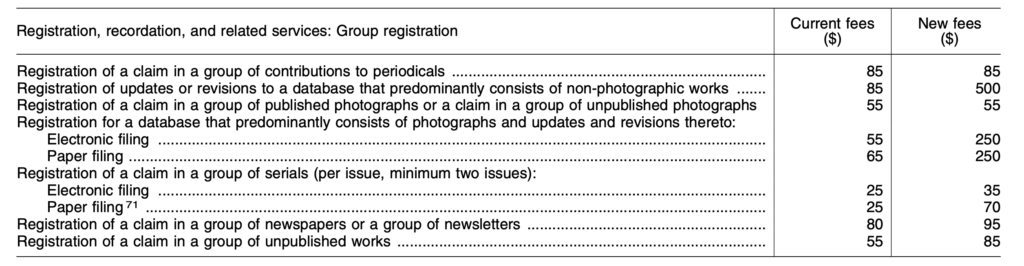
Starting March 20, 2022, the fees for registrations and other services from the US Copyright Office are going up. You can get the whole story in the Federal Register, here, but it’s a long slog of a read. Here’s the skinny:

There are more changes, but the screenshots above show the ones you are most likely to face.

The good news for photographers is that the fees for group registrations have not changed. The bad news for stock photo agencies is that the database registration for photos has jumped quite a bit ($250!).

Still, no matter how you slice it, registration is still the cheapest “insurance” you can buy.

Details Matter, But…

Legal things are notoriously detail-oriented. Whether you are getting a driver’s license or filing suit, the details are important. Sometimes, the teeniest details can make or break a case. You’ll always hear we attorneys harping on the details, and for good reason.

One of those reasons in my world is that, sometimes, getting the details wrong on a copyright registration can break (void) the registration. I’ve preached for years that you need to be careful with your registrations because certain errors can be so dangerous.

Luckily, near the end of February this year, the US Supreme Court issued its ruling in the Unicolors v H&M copyright case which may save some registrations. In that ruling, the court said, roughly, that an error of fact or of law, as long as it was unknowing, won’t break a registration. That is, the safe harbor under 17 USC §411(b)(1)(A) applies to both mistakes of fact and of law.

Now, here’s the important bit: unknowing. For a mistake to be truly a mistake, you can’t be willfully blind, for example. It won’t do for you to just say “I don’t know what to do so I’ll do whatever and it’ll be okay.” Nope. So, for example, if you have read my blog post about some of the details you need to pay attention to, like not mixing published and unpublished work in a group photo registration, and you don’t bother to check on the publication status of all the photos in a group registration, I would expect that registration could still be voided (at least in part).

So while this ruling is important, it really shouldn’t change how you approach your registrations. You still need to do your best to be accurate. But if you legitimately accidentally aren’t accurate and you sue with a flawed registration, you have a lower chance of being kicked out of court for a voided registration now.

Ah, the Case Act

Assuming that Trump actually signs the huge bill that includes the CASE Act, something that has not yet happened as I post this (and, knowing how crazy he is, it’s not a for-sure thing he will), the much-touted bill will become law. **UPDATE 12.28.20: he signed**
What does it change in copyright law and what does it mean for the average creator? Here’s my take…

First, the CASE Act changes nothing in existing law except that, before, you absolutely had to have a timely registration to get any statutory damages but you can get some without it under CASE; also, you can file a claim without having your certificate as long as you have filed an application for registration. For statutory damages, if you choose to use the small claims system without a timely registration, you can get very limited ones—up to $7500 per infringement but with a maximum per case of $15,000. That maximum limit means, for example, if one infringer used 3 of your photos, you can’t get more than $15K total, even though 3 x $7500 is more than that. As for the application/registration issue, you can file a small claim as long as you have applied for a registration and that application has not been refused. Under existing law, you must have a certificate in hand (or a refusal) to file suit. Under the CASE Act, if the registration application is later refused, the claim is dismissed but can be re-filed later (for example, if the registration is later fixed and then approved, file again). 

Besides those changes, the existing copyright law is left pretty much as it was, only added to with the small claims system regulations. For example, you can still get actual damages and the infringer’s profits attributable to the infringement in the small claims system, you still own the copyright from the moment of creation, the exclusive rights are still the same, the statute of limitations doesn’t change, etc.

What do you give up if you use the small claims system? Besides procedural things like the number of witnesses, discovery limits, etc., which are all lawyer stuff, really, here are the things people need to know they are giving up if they choose to use the new system:

  • The constitutional right to a jury trial
  • Increased damages for willful infringements
  • Appeal in the regular courts (there are appeal-ish procedures, in the small claims system, but no appeals or re-litigation in regular court)
  • Attorney’s fees, except for bad faith situations (notoriously hard to prove up) and then generally limited to $5000.

Also, you can’t bring claims for CMI removal or false assertion (§1202 claims), in the small claims system. That is a big deal, in my opinion, since you’d be giving up a minimum of $2500 (and up to $25K) per violation, and attorney’s fees, if you chose to use the small claims system. While this may change down the road (the bill requires study of issues in three years, including probably the §1202 one), for now, you have to let go of those claims. That is walking away from money.

Here’s the other thing: any party can opt-out, so you could be throwing away at least $100 (filing fee) and likely more (service costs, etc.) often, as your infringers say, “Nope, I won’t do the small claims court—sue me in regular court if you want to bring a claim!” and there is nothing you can do about it. 

But let’s say the opposing party doesn’t opt-out, and it’s a big enough company that it has in-house counsel or is willing to pay an outside attorney to represent it. If you were planning on going without an attorney, you’re going to get your ass kicked, more often than not. No matter how much the powers-that-be try to simplify the system, copyright lawyers simply know more than you and know how to use that knowledge to make the right kinds of arguments to other legal pros (those making the determinations in the small claims system). That means you’ll have to find counsel. If you can only get a maximum of $7500 and probably no attorney’s fees, it’s going to be much harder to find an attorney to take your matter on contingency or your going to have to pay an hourly rate that’ll eat up your award quickly.

I wrote a lot about how I didn’t like the CASE Act, as a litigator and counsel to copyright plaintiffs, in a post more than 3 years ago. My reasons still hold in regards to its final form, today. But if this is the new reality, I will, of course, work within it. As will we all. 

So, here’s what I still recommend for all creatives: apply for copyright registrations as soon as possible after the creation of your works. Just like before, this is still the best thing to do. Post-CASE, it is even more so. If you have a timely registration (effective date is either before the infringement started or the registration is made within 3 calendar months of the first publication of the work infringed—see here for more), and you choose to use the small claims system, the maximums increase to $15,000 per infringement and $30,000 total per claim. That’s double the amount available if the registration is untimely. 

Most importantly, a timely registration gives you much greater leverage to negotiate a settlement without filing a claim at all because your opponent knows you can file in regular federal court where the maximums are as they have been ($30K non-willful, $150K willful, per infringement and no maximum overall total, possible attorney’s fees). Also, you don’t have to give up your CMI-related claims (which, by the way, are not dependent on timely registration, see more here). When it comes to settlement negotiations, those timely registered factors and the CMI-related ones give a creative a much stronger starting position, which will generally result in more settlements, less litigation, and lower attorney’s fees (contingency fees often go up when any sort of litigation starts). More money in your pockets.

Now I know lots of creatives see the CASE Act as a good thing, and I get where they are coming from. It sounds great and it does open a door to getting some money that didn’t exist before. But I still think the downsides are significant. I also know that when I talk to other copyright lawyers who actually litigate, their positions have been much like my own.

As in all things legal, talk with your own attorney to learn what may be the best for you.
On FB/Insta’s Image Manager Tool

Recently, news broke that Facebook, owner of Instagram, is rolling out a new tool to “protect” photos across both platforms. See https://techcrunch.com/2020/09/21/facebooks-new-rights-manager-tool-lets-creators-protect-their-photos-including-those-embedded-elsewhere/ and https://about.fb.com/news/2020/09/helping-creators-and-publishers-manage-their-intellectual-property/. Call me a skeptic, but I’m not jumping for joy at this. While it looks better than nothing, I don’t trust Facebook to do anything that isn’t in its own best interest. More importantly, photographers need to be aware of what they may be losing and what risks they are taking if they use the tool.

My main concern about this new tool is that photographers will use the takedown part of the process too quickly and potentially hurt their ability to get the money they deserve from these infringements. At the very least, before issuing any takedown, photographers should make sure to capture as much evidence about the infringement, including screenshots and metadata, so that if they decide to go after the infringer, they have the proof they need.

Let me back up a bit because I suspect some readers may really understand the purpose of takedown notices and what they mean. That is, many people are not aware that when you send a takedown notice and the work is removed, you can still sue the poster/user for the infringement; you just can’t sue the ISP/platform (probably…there are other requirements the ISP must follow for this safe harbor from liability). Again, after a takedown notice, you can still go after the actual infringer—the person or entity that posted your photo to the platform.

However, to pursue an infringement, you need proof. If you send a takedown notice too quickly, you’ll lose your evidence. So, before doing anything like submitting a takedown notice, make sure to capture all the evidence you can—like screenshots of the use and any metadata you can gather. See my article on evidence gathering for more info. Better yet, talk to an attorney to see what your options are beyond a takedown, before pulling that trigger.

By the way, registering your copyrights before you release your work into the wild is always a good idea. However, you may still have a case even if you haven’t registered the copyright at issue yet. For example, maybe the infringer removed your watermark—that would be a violation of a different part of copyright law that doesn’t require registration for you to be eligible for statutory damages and maybe even attorney’s fees and costs (more on that here).

Worse, however, than losing the evidence needed to pursue the infringement is that if you send a takedown notice too quickly, you may not do the research necessary to make sure that the use is actually an infringement and not excused by fair use or some other defense. If you send a takedown notice without doing that research, you can be sued by the user of your photo for submitting a bad faith takedown notice! If that happens and you lose that suit, you could end up paying the other side’s legal fees. Ouch!

So, if you are still using Facebook or Instagram (and I heartily encourage you not to for many reasons, including the facilitation of the downfall of democracies worldwide), you might consider using this new tool. If you do, take care to use it right.

Copyright Registration Suggestion

I’ve written a lot on the importance of registering your copyrights and, no, this won’t be another nag on that topic. Instead, I want to talk about something you aren’t required to do when you register, but which would be potentially very helpful down the line: make copies of your deposit copy uploads.

Often, an infringement defendant will demand proof that the work was submitted to the USCO as a deposit copy in the registration cited. Now, it’s not the plaintiff’s responsibility to provide that proof[1], particularly if the registration is before or within 5 years of the first publication of the work, but it does help shut up a defendant if you can whip out screenshots of your upload pages along with the works so that they can see, yup, that work was indeed included in the deposit copies submitted to the USCO.

Keeping a folder of everything you submit to the USCO for a registration is a great idea, and if you aren’t doing that yet, start. I suggest you keep copies of the titles list (for group registrations), the actual files submitted, any correspondence you get from the USCO (or send in reply), etc. When you get your certificate, make a scan of it and include the whole thing in that folder, too. Making screenshots of things like the upload page(s) and confirmation(s) takes little time but completes that folder[2]. Then, when the infringer tried its “prove the work is in there” you can not only show the list of title names on the certificate, you can show the work as it was submitted. That’ll shut ’em up… at least on that point.

Basically, the idea is to take away as many of the BS defenses defendants try to assert whenever they’re caught ripping off work. For example, use a proper copyright notice on or adjacent to each work you publish on your website and then no one can claim “innocent infringement” (more on that, here). This “is it in the registration” issue can be a big block with some defendants; removing their ability to claim the work isn’t part of a cited registration can significantly help move negotiations forward.

The more evidence you have to support your claims, the more likely your attorney will be able to negotiate a good settlement for you, so it’s worth the minor effort to make those copies, even if it isn’t your legal responsibility to do so.

______________

[1] This point was again made in the recent Iantosca v Elie Tahari, Ltd. No. 19-CV-04527 (MKV), 2020 WL 5603538 (S.D.N.Y. Sep. 18, 2020) where the court noted “It is the Defendant’s obligation, during discovery, to contact the USCO and request deposit copies to be used to rebut the validity of the copyright registration.”

[2] Remember, when you make the screenshots, the metadata about their creation date, etc., will be in those screenshot files, too. More handy proof in case they try to claim you created the screenshot, nefariously, later (and yes, they might).

Bad Registration Advice

Recently, I was approached by a photographer about an infringement matter. It was a good-looking case, until I checked the registration. The work had been registered as unpublished, but it was admittedly published before being registered; in other words, it was knowingly registered wrongly. That makes a big “No, can’t take this on contingency” from me.

When I explained this to the photographer, the response was surprise if not full-on skepticism. Seems the photographer had been told, allegedly from several sources including at least one major national photographers’ organization, that one could register a work as unpublished if registered within 90 days of publication. 

Yikes. The amount of wrong there is worrisome.

Let me make this perfectly clear: one must never knowingly register a published work as unpublished. Ever. There is no way around it, short of lying, and lying is a very, very bad idea. Full stop. 

Registering under the wrong publication status is bad; but registering work you know was published as unpublished is a fast route to having the registration voided for that work. Now, if you are litigating and you get busted for the “error,” you will quite possibly (I’d say probably) end up paying the other side’s attorneys’ fees when you lose your case. Ouch.

Look, we pretty much all hate the published/unpublished thing—lawyers, artists, everyone. It’s an administrative hoop that is, in my opinion, arguably outdated and unnecessary. But, it is very much still the law. 

When a work is published, one must provide the US Copyright Office with additional information about that work in its registration application (date and place of first publication). That data is included in the certificate and USCO records. Registering the work as unpublished omits this information. That’s why it’s particularly bad.

So, where did this photographer’s misinformation come from? Hard to tell, but I suspect it was started by someone trying to get around certain limitations in order to register more works for less money. See, before the recent-ish changes in registration procedures, one could register a virtually unlimited number of unpublished photos in one “unpublished collection” registration. The limit was one of upload size, not number of works. However, published photos were limited to 750 per group registration (as well as other limiting factors, like the photos must be published in the same calendar year). In other words, it would cost more to register 1500 published photos than unpublished ones. 

This irked photographers. I know, I’ve been asked at talks I’ve given about copyright registration, back when those rules applied, “Can’t I just say the work is unpublished so I can do everything in one registration and save money? Who’s gonna know?” Of course, I pointed out the errors of that line of thinking, but I’m sure some may have errantly given it a try. Thing is, the USCO relies on you being honest so if you do misrepresent the work as unpublished, you will still get your certificate. But that doesn’t mean it will hold up in court. Anyhoo, once someone did it and got his* certificate, the info likely got shared and, boom, bad info gets out to the photo world.

Now, the rules are more equal. There is no more “unpublished collection” for photographs but rather Group Registration of Unpublished Photographs (GRUPH). That registration, like for published photos, is limited to 750. Like it or not. So, the incentive to misrepresent a work’s status is much less now. 

The 90 days thing, though, in the photographer’s response above? Well, that is extra rules-bolluxing. Contrary to popular thought, there is no 90-day anything in copyright registration for photographs. There is, however, the 3-calendar-month safe harbor for registering published photographs. It is NOT 90 days, but many people have wrongly said/written it as such. Remember, three months does not equal 90 days (hello, February) and you can get bitten if you get that wrong. Anyway, I think that safe harbor got mixed into the mess and we end up with this strange idea that there is a way around the publication status-related registration rules. 

You can fix bad registrations, but it is a process and it will cost you both USCO and your own attorney’s fees. Oh, and when the error is like what I’ve been talking about here, you’re almost surely going to get a new effective date, too (that can affect statutory damages for some cases). 

This stuff can be complicated. Remember, while your creative friends may think they know the rules, if you have any questions regarding your registrations, your best bet is to hire a copyright attorney for legal advice.

New Ruling Says Public Instagram Means No Infringement

A federal court (SDNY) has just ruled that a case must be dismissed because the photographer-plaintiff had posted the work on Instagram, with the account “public,” so the photographer granted a license to Instagram that included permitting Instagram to re-license it, including to the defendant (THR article about the ruling, here). So, the defendant (Mashable) had a license to display the photograph at issue via the Instagram API, and thus the case was dead. 

In other words, there was no infringement by the defendant since the photographer posted the work publicly on Instagram. YIKES! 

Now, this ruling does NOT say that it would be okay for a defendant to copy or download a photo it saw on Instagram and use it on its website for any purpose, but the door is open to defendants to try that, even if it might not be a winner. Here, Mashable used Instagram’s API to embed the work into its story; those facts may be the key points, but the terms of service for Instagram are very broad and, frankly, I’m surprised there hasn’t already been this result. Defendants will lock on this ruling and argue it, even in cases where the facts do not include API use.

While this is just one court, the implications are profound and, frankly, something I have predicted for some time. Also, remember that Facebook is as bad.

I know many of you would argue that you won’t be seen unless you use these platforms. I have to tell you that is simply not true and rather are stories told by the platforms and by clients/users, neither of whom have your best interests in mind. While sure, you don’t want to make things hard on your clients, you must balance that with what risks are reasonable (or not) for your business.

In my opinion, best practices for visual artists, especially photographers, is not to use Instagram or Facebook to display work. Keep your work on your own servers or use a reputable tool/host like PhotoShelter. If you have Instagram or FB accounts, I suggest deleting them asap and leaving a post directing your followers to your own website, instead. If they ask why, tell them you value your work and can’t afford to give away your rights.