The CASE for Disappointment

I finally got the time to read the amendments to the final rules for the Copyright Claims Board (aka CCB, the CASE Act’s small claims system) and, well, I’m disappointed. 

First, it’s clear that a lot of thought went into the choices made, but the feeling I get from reading the Federal Register is that more weight was given to “protecting” defendants than enabling artist-plaintiffs. While many accommodations were made for pro se parties (that is, parties who do not have lawyers representing them in the process), and many of those accommodations can help both sides, overall, I think the final rules make it much more difficult for artists to participate, to win, or to win enough to make the process worth their efforts, represented or not. Worst of all, the whole system is vastly more limited than it was expected to be.

First, and generally speaking, here’s how the process works:

  1. File a claim using the online fillable form system and have it reviewed by the CCB’s attorneys for sufficiency; if it is, move to step 2, if not, fix the claim or drop it.
  2. Serve the Initial Notice (the claim) on the opposing party; if it doesn’t opt out, then it will file its response.
  3. The board with then issue a scheduling order with dates for things like pre- and post-discovery conferences, discovery deadlines, etc. 
  4. Discovery, the part of the system where the sides gather info from each other, occurs and this is very limited by the rules. Forms will be used for almost all of this, too, except for the parties’ written statements.
  5. Discovery closes and, if needed, there is a hearing (virtual) on the matter.
  6. The board issues its final determination, and the parties learn who wins/loses and what any award may be.
  7. A request for reconsideration can be filed after that, but it’s unlikely it will change things, especially since one can’t add any new evidence or the like.

My first issue is that a defendant gets 3 strikes before a default is even considered. That is, a plaintiff files a claim, but the other side never responds or the other side agrees to the process and then later stops participating. In federal court, a plaintiff could move for a default, which is the court’s way of saying “you didn’t defend so the plaintiff wins.” In the CCB, the board will contact a non- or disappearing defendant twice more to give them the opportunity to respond (“cure” the error) before it will even think about calling it a default and awarding damages to the plaintiff. That, to me, just seems like enabling bad behavior. Although the board claims that its ability to award attorney’s fees (if it chooses!) for bad behavior will discourage it, I don’t think that’ll make a difference in the long run.

Second issue is that the discovery tool Requests for Admission (RFA) aren’t used unless a party asks to use them and shows good cause for their use (a big hurdle). Moreover, even if you do get permission to use them, if they are not responded to, they are not admitted, as they are in federal court. See, in federal court, you can send RFAs to the opposing party and they must admit or deny them (in part or whole) or state that in good faith they cannot answer because they don’t have the info to answer. If they don’t answer any one or all of the RFAs in any of those 3 ways, that or those RFA/s is/are deemed admitted as fact. Without having that consequence for non-response, RFAs are essentially useless. At most, the board can use the failure to respond as negative generally against the party, but even that is at its discretion. Big whoop.

Third, there are no depositions permitted. Period. None. Nada. No forcing the other side to look at you and answer questions under oath. Now, I could understand permitting only depositions of the parties or some other limitation, but flatly saying “no depos” is bad. I can’t imagine going into court without deposing the other party, if only to get them on record for when they later say something completely different to the court. But here, nope. None. All you get is the other side’s written statement. True, that’s all they get from you as well but, if you bring the claim, you’ve hopefully got nothing to hide anyway so a depo is not a worry. But not getting the infringer to answer questions… hamstringing.

Fourth, if a defendant agrees to mitigate or cease using the work voluntarily rather than being compelled to do so, that fact will be considered in mitigation of damages. This is infuriating to me. Someone steals a work, uses it, and then when they get caught and finally stop, they get a credit for doing so. WTAF?! Instead, the opposite should occur: if an order is required, the damages are doubled or something like that. 

Fianlly, and as if all that isn’t bad enough, the very worst part to me is that a party is limited to only 10 claims per year with the CCB. Relatedly, any attorney is limited to only 40 claims per year (80 total for a firm—even if that firm has 1000 attorneys!). The rationale is that these limits will avoid so-called trolling but, considering the fact that artists of all kinds often have hundreds if not thousands of claims a year, this just sucks. Instead of being able to use this tool or have your attorney use it, you’ll have to pick and choose what cases to bring at all. Moreover, copyright attorneys will be even more reluctant to take smaller or difficult cases, since we’ll be so limited as to how many we may bring on behalf of all our clients.

And don’t get me started on how this is restraint of trade for us attorneys. Grrr.

These aren’t all my complaints about the system, but they are the big ones. It’s disappointing, to say the least. Overall, CASE was sold to the people as an effective alternative to federal court and an option for those who haven’t timely registered their works. Instead, it is turning into a greatly limited system that gives infringers all sorts of opportunities to get away with lower damages and continued poor behavior. 

The good news is that you can still register your works and use the traditional federal court system. If you timely register your works, you also give attorneys like me a great tool to negotiate a settlement on your behalf without having to resort to filing suit at all. 
On Being Reasonable

Whenever I take an infringement matter on contingency, I ask my client to think about what settlement amount would make them content, that is, what amount they could live with, not the amount they really would love to get. This is the bottom-line number. More is good, but every client should have an idea of their floor for settlement.

This number should be reasonable, of course, not greedy. For example, saying “I won’t take less than $20K!” for a photo used in a tweet by a regular ol’ individual is not reasonable. Nor, however, should it be a too small number (unless, for some reason, the circumstances really warrant that). Nope, the lowest reasonable settlement amount number should be something that, if you ended up with that amount, you’d say to yourself something like “I can live with this, without seething.” Besides, the other side isn’t going to get that number–it’s an internal one so we all know what we are working to achieve, at a minimum.

Once we have that number, the first offer will be significantly more–to give us room to negotiate. I won’t, however, suggest that we start at $30K or $150K, the maximum statutory damages amounts (speaking of an infringement only, here). Why? Because it’s not a sign of willingness to compromise if you start by asking for the maximum available. Yes, the law says you are entitled to something between $750 and $30K/$150K (assuming a timely registration), but the maximum damages are not often awarded and you’ll just appear greedy if you start there.

Starting off appearing greedy is not conducive to working with the other side to a settlement. If the starting number is irrationally high, it won’t increase the end number but it likely will impede settlement negotiations. Instead, starting off with a high-ish but rational number will let the other side know we’re serious and yet also willing to compromise. It opens the door to working together to a settlement.

If, despite this, the negotiations don’t work out and litigation is required, being reasonable pre-litigation will also help you in litigation. Courts do not like plaintiffs who simply demand the maximum damages, particularly when the facts don’t reasonably support that kind of award. In fact, in a recent case, the court refused to award attorneys’ fees to a winning plaintiff for that reason (pdf of the opinion, here).

While infringements are a pain and take up far too much of an artist’s time and effort, one shouldn’t look at them as a windfall. A court will suss that motivation out and it will not end well. But, if you are reasonable about your demands and your expectations, and rational in your negotiations, you can end up with enough money to make up for all the hassle.

Time

In copyright law, time matters in several ways. Each is important.

First, there is the timing of the registration which fits into three categories. Generally speaking, you should register your work as soon as possible after its creation. More specifically, though, a registration that is made before a work’s first publication* will make enhanced remedies (i.e., statutory damages and possible attorney’s fees) available for virtually any infringement of that work. A registration within three calendar months after the first publication* of a work will invoke a bit of legal magic: the law says it is as if you registered the work on the day of its first publication*, again making enhanced remedies available for virtually any infringement. Finally, any infringement that starts after a work’s registration, no matter when the work was registered vis-a-vis its publication* date, has enhanced remedies available.

(*Publication here is that awful, nebulous definition provided by the Copyright Act–it does not necessarily mean what a normal person would think publication means. )

Time also matters as regards the statute of limitations–that is, the amount of time you have to file a suit for infringement. The statute of limitations is a strict clock–so pay attention to it.

In most places in the USA, courts have held that the discovery rule applies, meaning the clock starts when you discover (or reasonably should have discovered) an infringement. From that date, you have 3 years to file suit. 3 years is a lot of time to find, document, and try to work out a non-litigation resolution to an infringement. But it isn’t all the time in the world and you should make a big note in your calendar about 6 months before the 3 years would end, so that you can talk to a lawyer about filing in plenty of time.

In a few places, courts have said that the injury rule applies (mostly the 2nd and the 11th circuits, but even in those circuits there have been some exceptions). The injury rule means that the clock starts when the infringement actually starts, not when you discover it. I happen to think that the Raging Bull case (Petrella v. Metro-Goldwyn-Mayer, Inc., 572 U.S. 663, 677-78 (2014)) essentially said that the discovery rule should apply everywhere (sure, in dicta, but still), but you don’t want to rely on that in court. At least not yet.

By the way, if you don’t know what circuit you’re in, you can check out the Court Finder tool on the US Courts website; or, better yet, ask your attorney.

While there are a few situations where the law permits “tolling the statute” (that means suspending it for a period of time, thus giving you more time), those exceptions are complex and rare. You shouldn’t rely on your attorney finding some obscure out to give you more time. Instead, once you find an infringement, act quickly to start the process of resolving the matter–preferably through settlement negotiations if possible.

But all of the negotiations in the world will only get you a little money (usually) if you don’t have a timely registered copyrights in the works at issue in the first place.

Don’t Forget to Transfer Your Copyrights Into Your Trust

Photo © 2017 Leslie Burns

If you have a trust, especially for estate planning purposes, have you transferred your copyrights into that trust? Remember, copyrights are descendible assets, meaning they go to your heir(s) when you die. But, if you don’t put them in your trust, they may end up in the hands of someone you didn’t want to get them. 

Allow me to back up a bit. …copyrights, in the USA, last for 70 years after the death of the (human, non-entity) author/creator. They exist at the moment of creation—when the work is created, the copyright automatically exists. Registration provides extra protection, particularly in the form of additional remedies for infringement but, even without registration, the asset (the copyright in a work) exists when the work is created and lasts 70 years after the artist’s death. So, just like any other asset, you need to pick who gets yours when you leave this life. 

Many people have revocable trusts created to ease the transfer of assets after death. Briefly, these trusts are changeable throughout your life (hence “revocable”) and hold the assets in the trust for the benefit of the beneficiary who is, while you’re alive, you (or if it is with your spouse, both of you). When you die, the trust becomes irrevocable and the beneficiary/ies get the assets included in the trust, as per its terms. Trusts avoid probate and, thus, get the assets to the beneficiaries much more quickly and easily than a traditional will (which, by the way, is still much better than nothing!!).

Sadly for creatives, many trust and estate lawyers don’t know even to ask about copyrights when it comes to your assets. In that situation, those otherwise competent lawyers may not advise you properly about transferring your copyrights to your trust. No formal transfer and the copyrights will not go to whomever you actually wanted to get them. 

A trust, even your own trust, is not you; so, just like you have to transfer a car title to put the car in your trust, so must you transfer the title (so to speak) in your copyrights. Transferring a copyright requires a signed writing to be valid. That is, the current owner of the copyright(s) has to sign (and yes, it can be electronically) a document that explicitly says that she/he/they is/are transferring ownership to a new owner. 

I recently worked with a client’s trust attorney to do exactly that—draft the documentation needed to get those copyrights into the new trust. Luckily, both the client and the other attorney were wise enough to ask about copyrights when it came to the list of assets to be included in the trust; and I was more than happy to help out with that paperwork. Make sure that, if you decide to go the trust route for your estate, you don’t miss out on transferring your copyrights, too. It may be a bit of additional cost, but it shouldn’t be much and your beneficiaries will thank you for it, later.

USCO Fees Increasing

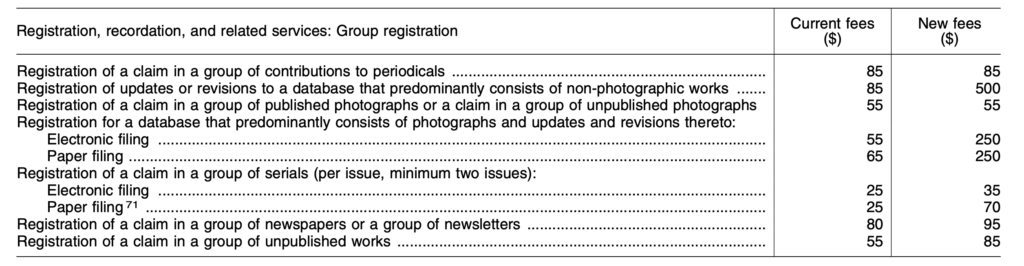
Starting March 20, 2022, the fees for registrations and other services from the US Copyright Office are going up. You can get the whole story in the Federal Register, here, but it’s a long slog of a read. Here’s the skinny:

There are more changes, but the screenshots above show the ones you are most likely to face.

The good news for photographers is that the fees for group registrations have not changed. The bad news for stock photo agencies is that the database registration for photos has jumped quite a bit ($250!).

Still, no matter how you slice it, registration is still the cheapest “insurance” you can buy.

Details Matter, But…

Legal things are notoriously detail-oriented. Whether you are getting a driver’s license or filing suit, the details are important. Sometimes, the teeniest details can make or break a case. You’ll always hear we attorneys harping on the details, and for good reason.

One of those reasons in my world is that, sometimes, getting the details wrong on a copyright registration can break (void) the registration. I’ve preached for years that you need to be careful with your registrations because certain errors can be so dangerous.

Luckily, near the end of February this year, the US Supreme Court issued its ruling in the Unicolors v H&M copyright case which may save some registrations. In that ruling, the court said, roughly, that an error of fact or of law, as long as it was unknowing, won’t break a registration. That is, the safe harbor under 17 USC §411(b)(1)(A) applies to both mistakes of fact and of law.

Now, here’s the important bit: unknowing. For a mistake to be truly a mistake, you can’t be willfully blind, for example. It won’t do for you to just say “I don’t know what to do so I’ll do whatever and it’ll be okay.” Nope. So, for example, if you have read my blog post about some of the details you need to pay attention to, like not mixing published and unpublished work in a group photo registration, and you don’t bother to check on the publication status of all the photos in a group registration, I would expect that registration could still be voided (at least in part).

So while this ruling is important, it really shouldn’t change how you approach your registrations. You still need to do your best to be accurate. But if you legitimately accidentally aren’t accurate and you sue with a flawed registration, you have a lower chance of being kicked out of court for a voided registration now.

Long Time No See

You may have noticed that I haven’t posted in a while; in almost a year, to be more accurate. I have no excuse other than this: I’m human and it’s been a hell of a year, or two. 

We all have had a hell of a year, or two. 

Professionally, during this time, the most important thing has been my clients. That is, I have been putting all my work energies into taking care of their business, their cases, their needs. My clients will always be my priority when it comes to my professional life; and 2021 ended up being a successful year for many of their matters, happily. But, when they were taken care of, I found I had to devote my energy to taking care of myself and my loved ones. Things like blogging about the law took a lower position. 

Life in the pandemic made everything quotidian much more difficult, turning things like the previous quick runs to the grocery into a bigger, rarer shopping trip, with masks and (at first) gloves and long lines. Everyone had to deal with that, of course. We added in the rearing a Blue Heeler puppy, which is joyful and frustrating in ping-ponging measures, and a general time suck, and totally worth it. 

Mongo Santamaria with Ruth Bader Catzburg

At home, we had the unexpected COVID-related death of my boyfriend’s father and trying to help plan his military burial months later when COVID restrictions permitted. Sadly, he left virtually no specific instructions as to his wishes, despite having a decent estate plan otherwise. I mention the last not to speak ill of the dead but rather, wearing my lawyer’s hat, to ask you to not be like that—please leave instructions in your estate plan for what you want/don’t want for your funeral/memorial—your family will be greatly relieved. On the other side, when someone you love dies, please follow the instructions of the executor (or a lawyer, especially if there is no trust/will) rather than going off on your own and trying to, say, sell their car before the title has been correctly transferred or giving away the deceased’s personal items, even if you think it would be helpful. Yes, we had to deal with that happening, too.

Anyway, whether it was general life stuff or the dog or family or the estate stuff or work, the mental load was more arduous than the physical. Again, this is true for everyone. Also, the political situation here in the USA has added to general stress, and now we’re facing an aggressive Russia, invading Ukraine, for extra yikes. 

So, while I wish I had been better about blogging here, I will say I’m not beating myself up too much about it. I learned shortly after I started law school that taking a step back to make sure that you are taking care of yourself is important. That can mean saying “no” to more things than you expect to or changing your priorities as your life changes. It’s okay to not do everything, in fact, it’s likely better to do less to do it well.

I hope you each take the time to look at what really matters in your life now and set your priories based on that. Be proud of what you have accomplished, especially if you have managed to stay in business during the pandemic, but don’t let your business be the only thing that matters. Be there for your loved ones rather than pushing for that extra buck, too. 

All that being said, I hope to step up and be more active here in the coming days and months. Since my mentor Carolyn Wright shut down her PhotoAttorney blog (to enjoy a well-earned retirement), I feel the need to step into the gap as much as I can.

Tax Reporting (1099) Changes

While we’ve all been distracted by things like the attempted coup, it seems that there was an important change in tax reporting that you need to be aware of. Many of you have hired independent contractors and have issued 1099MISC forms to report those payments; this year, it’s different.

If you had payments to independent contractors in 2020, more than $600 to anyone, you need to report those on a new form, called 1099-NEC. Here is the IRS flyer with the full information (pdf), but the short answer is that the 1099-NEC must be provided to your vendors by January 31, 2021 and reported to the government by that same date!

If you have been hired as an independent contractor, you should received your 1099-NEC from your client(s) by January 31, 2021 as well.

It gets a bit more squirrel-y when it comes to payments to attorneys: we can get both forms for the money we receive. It just depends on what kind of payment we get–settlement or payment for our fees.

If you paid a settlement, for example, to an attorney on behalf of a claimant, then you need to report that whole amount (“gross proceeds to an attorney”) on the revised 1099MISC in BOX 10 (it used to be box 14). You must also report that whole amount on a 1099-NEC in BOX 3 sent to the claimant! See the bottom of page 2 and top of page 3 of the pdf I linked to above for examples.

However, if you hired an attorney (like me) directly and paid more than $600 in attorney’s fees to that attorney (or firm–even attorney corporations must have their payments reported), you need to report that on the new 1099-NEC in Box 1.

Leave it to the IRS to make an already complicated system even more so. 😉

Oh, and in some states, these changes mean you need to send information to states differently. You should check your own situation, to be sure. The vendor track1099.com has a tool to check, but best to check with the tax authorities in the states involved.

If you have questions about these new processes, you should contact your CPA for best advice.

Ah, the Case Act

Assuming that Trump actually signs the huge bill that includes the CASE Act, something that has not yet happened as I post this (and, knowing how crazy he is, it’s not a for-sure thing he will), the much-touted bill will become law. **UPDATE 12.28.20: he signed**
What does it change in copyright law and what does it mean for the average creator? Here’s my take…

First, the CASE Act changes nothing in existing law except that, before, you absolutely had to have a timely registration to get any statutory damages but you can get some without it under CASE; also, you can file a claim without having your certificate as long as you have filed an application for registration. For statutory damages, if you choose to use the small claims system without a timely registration, you can get very limited ones—up to $7500 per infringement but with a maximum per case of $15,000. That maximum limit means, for example, if one infringer used 3 of your photos, you can’t get more than $15K total, even though 3 x $7500 is more than that. As for the application/registration issue, you can file a small claim as long as you have applied for a registration and that application has not been refused. Under existing law, you must have a certificate in hand (or a refusal) to file suit. Under the CASE Act, if the registration application is later refused, the claim is dismissed but can be re-filed later (for example, if the registration is later fixed and then approved, file again). 

Besides those changes, the existing copyright law is left pretty much as it was, only added to with the small claims system regulations. For example, you can still get actual damages and the infringer’s profits attributable to the infringement in the small claims system, you still own the copyright from the moment of creation, the exclusive rights are still the same, the statute of limitations doesn’t change, etc.

What do you give up if you use the small claims system? Besides procedural things like the number of witnesses, discovery limits, etc., which are all lawyer stuff, really, here are the things people need to know they are giving up if they choose to use the new system:

  • The constitutional right to a jury trial
  • Increased damages for willful infringements
  • Appeal in the regular courts (there are appeal-ish procedures, in the small claims system, but no appeals or re-litigation in regular court)
  • Attorney’s fees, except for bad faith situations (notoriously hard to prove up) and then generally limited to $5000.

Also, you can’t bring claims for CMI removal or false assertion (§1202 claims), in the small claims system. That is a big deal, in my opinion, since you’d be giving up a minimum of $2500 (and up to $25K) per violation, and attorney’s fees, if you chose to use the small claims system. While this may change down the road (the bill requires study of issues in three years, including probably the §1202 one), for now, you have to let go of those claims. That is walking away from money.

Here’s the other thing: any party can opt-out, so you could be throwing away at least $100 (filing fee) and likely more (service costs, etc.) often, as your infringers say, “Nope, I won’t do the small claims court—sue me in regular court if you want to bring a claim!” and there is nothing you can do about it. 

But let’s say the opposing party doesn’t opt-out, and it’s a big enough company that it has in-house counsel or is willing to pay an outside attorney to represent it. If you were planning on going without an attorney, you’re going to get your ass kicked, more often than not. No matter how much the powers-that-be try to simplify the system, copyright lawyers simply know more than you and know how to use that knowledge to make the right kinds of arguments to other legal pros (those making the determinations in the small claims system). That means you’ll have to find counsel. If you can only get a maximum of $7500 and probably no attorney’s fees, it’s going to be much harder to find an attorney to take your matter on contingency or your going to have to pay an hourly rate that’ll eat up your award quickly.

I wrote a lot about how I didn’t like the CASE Act, as a litigator and counsel to copyright plaintiffs, in a post more than 3 years ago. My reasons still hold in regards to its final form, today. But if this is the new reality, I will, of course, work within it. As will we all. 

So, here’s what I still recommend for all creatives: apply for copyright registrations as soon as possible after the creation of your works. Just like before, this is still the best thing to do. Post-CASE, it is even more so. If you have a timely registration (effective date is either before the infringement started or the registration is made within 3 calendar months of the first publication of the work infringed—see here for more), and you choose to use the small claims system, the maximums increase to $15,000 per infringement and $30,000 total per claim. That’s double the amount available if the registration is untimely. 

Most importantly, a timely registration gives you much greater leverage to negotiate a settlement without filing a claim at all because your opponent knows you can file in regular federal court where the maximums are as they have been ($30K non-willful, $150K willful, per infringement and no maximum overall total, possible attorney’s fees). Also, you don’t have to give up your CMI-related claims (which, by the way, are not dependent on timely registration, see more here). When it comes to settlement negotiations, those timely registered factors and the CMI-related ones give a creative a much stronger starting position, which will generally result in more settlements, less litigation, and lower attorney’s fees (contingency fees often go up when any sort of litigation starts). More money in your pockets.

Now I know lots of creatives see the CASE Act as a good thing, and I get where they are coming from. It sounds great and it does open a door to getting some money that didn’t exist before. But I still think the downsides are significant. I also know that when I talk to other copyright lawyers who actually litigate, their positions have been much like my own.

As in all things legal, talk with your own attorney to learn what may be the best for you.